
Difference Between Plate Type and Shell Type Heat Exchanger – Know From Best Heat Exchanger Singapore Experts Ad-Meth Mech
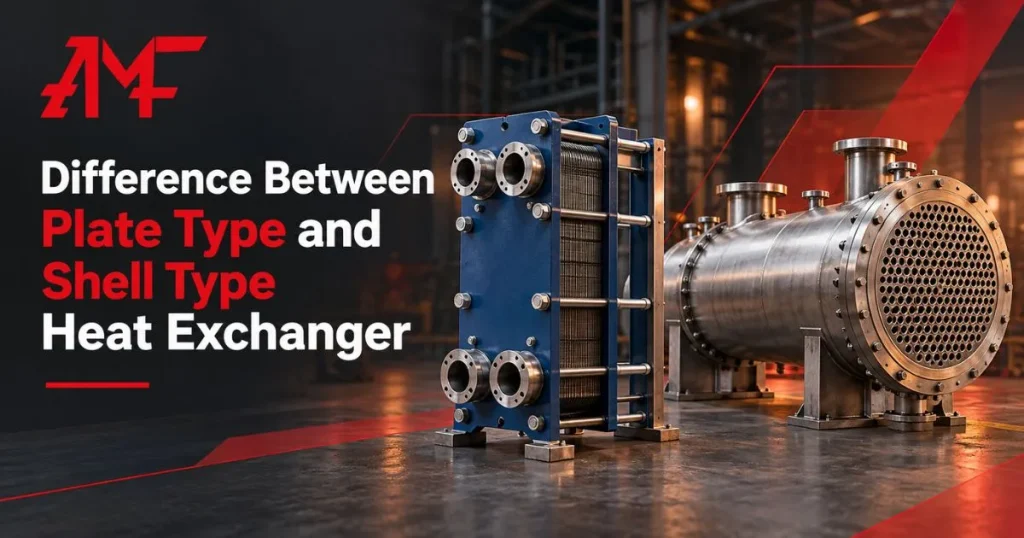
Heat exchangers play an important role in Singapore’s industrial sector, particularly in petrochemical, oil and gas, chemical, pharmaceutical, marine, and process manufacturing facilities. When selecting a heat exchanger Singapore companies can use for heating, cooling, condensation, or heat recovery, two common designs are plate heat exchangers and shell-and-tube heat exchangers.
But what is the difference between plate type and shell type heat exchanger? Although both systems transfer heat between two fluids without normally allowing them to mix, their construction, flow arrangement, maintenance requirements, space requirements, and suitability for different process conditions are not the same.
For companies operating process equipment in Singapore, understanding these differences can help engineers and maintenance teams identify the right heat exchanger configuration for a particular application.
What Is a Heat Exchanger?
A heat exchanger is equipment designed to transfer thermal energy from one fluid to another. Depending on the process, the fluids may be liquids, gases, or a combination involving phase change such as condensation or boiling.
The two fluids are separated by a heat-transfer surface. Heat passes through this surface while the fluids remain physically separated.
Heat exchangers are used throughout industrial facilities for duties such as process cooling, process heating, heat recovery, steam condensation, and temperature control.
In Singapore, heat exchanger equipment is particularly relevant to process-intensive industries. Local engineering companies provide services ranging from heat exchanger design and fabrication to cleaning, refurbishment, retubing, and on-site installation. Ad-Meth Mech-Field Pte Ltd, for example, has provided heat exchanger and mechanical services to Singapore’s petrochemical and process industries since 1991.
Plate Heat Exchanger vs Shell-and-Tube Heat Exchanger our Heading Text Here
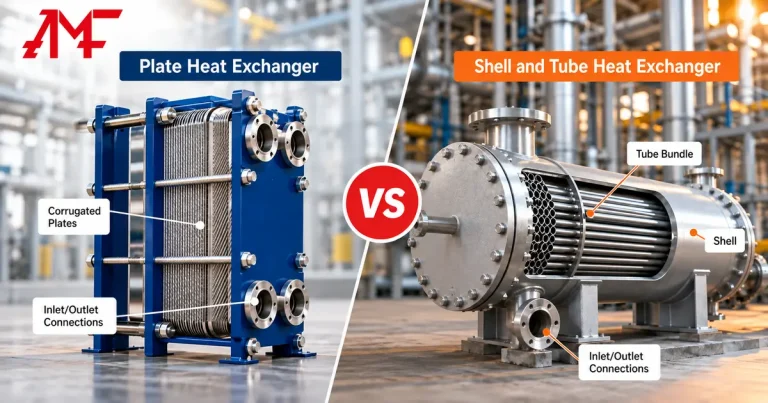
The most important difference between plate type and shell type heat exchanger is the way the heat-transfer surface is constructed.
A plate heat exchanger uses a series of thin, corrugated plates. The plates create separate channels through which the hot and cold fluids flow. The metal plates separate the fluids and provide the surface through which heat is transferred.
A shell-and-tube heat exchanger uses a bundle of tubes installed inside a cylindrical shell. One fluid generally passes through the tubes while the other flows through the shell side around the tubes.
Both designs can provide effective heat transfer, but their suitability depends on the process conditions and equipment specification.
Plate Heat Exchanger: How Does It Work?
A typical gasketed plate heat exchanger contains multiple corrugated metal plates arranged in a frame. Gaskets direct the fluids through alternating channels while preventing them from mixing.
The corrugated pattern creates turbulence and provides a large heat-transfer surface within a relatively compact package. This makes plate heat exchangers particularly useful for many liquid-to-liquid heating and cooling applications.
Their compact construction can be valuable in Singapore facilities where available equipment space is limited. A local Singapore industrial heat-transfer provider, for example, describes plate heat exchangers as a space-efficient option alongside shell-and-tube designs.
Plate heat exchangers are commonly found in applications such as:
- Industrial heating and cooling
- HVAC systems
- Refrigeration
- District energy systems
- Food and beverage processing
- Chemical processing
- Heat recovery
However, the exact suitability of a plate heat exchanger depends on the fluid properties, pressure, temperature, fouling characteristics, materials, and specific plate design.
Shell-and-Tube Heat Exchanger: How Does It Work?
A shell-and-tube heat exchanger consists of tubes contained within a larger shell. Tube sheets hold the tubes in position, while heads and other components control the flow through the tube side.
On the shell side, baffles may be used to support the tubes and guide the fluid across the tube bundle. The resulting flow pattern can increase turbulence and improve heat transfer.
Shell-and-tube heat exchangers are widely used in demanding process environments, including chemical processing, oil and gas, petrochemical facilities, and power generation. Manufacturers serving Singapore’s process industries provide both standard and custom shell-and-tube designs for these types of applications.
The design can also be adapted for different duties, including heating, cooling, condensation, and boiling.
Key Difference Between Plate Type and Shell Type Heat Exchanger
The two designs can be compared across several important engineering considerations.
1. Construction
A plate heat exchanger uses a stack of corrugated plates to create alternating flow channels. A shell-and-tube heat exchanger uses a tube bundle enclosed inside a shell.
This basic construction affects how the equipment is cleaned, inspected, repaired, and configured for different process requirements.
2. Heat Transfer Performance
Plate heat exchangers can achieve strong heat-transfer performance because their corrugated plates promote turbulence and provide a high effective heat-transfer area within a compact arrangement.
Shell-and-tube heat exchangers can also provide excellent thermal performance when properly designed. Tube diameter, tube length, number of passes, shell-side flow, baffle arrangement, fluid properties, and allowable pressure drop all influence performance.
For this reason, it would be inaccurate to say that one type is always more efficient. The appropriate design depends on the actual thermal duty.
3. Space Requirements
One of the main advantages of many plate heat exchanger designs is their compact footprint. This can be particularly useful in Singapore industrial plants, where equipment layout and available installation space can be important design considerations.
Shell-and-tube exchangers generally require a larger physical envelope because they include the shell, tube bundle, heads, tube sheets, and access requirements. However, the required size varies significantly according to the process duty.
A Singapore petrochemical case study published by Alfa Laval demonstrates how a compact welded plate heat exchanger was used where conventional shell-and-tube equipment would have required multiple large units because of process and space constraints.
4. Pressure and Temperature
Operating pressure and temperature are critical when selecting a heat exchanger. Shell-and-tube designs have a long history of use in high-temperature and high-pressure process applications. Their mechanical design can be customized according to the required operating conditions, materials, and applicable standards.
Plate heat exchangers can also be engineered for demanding services, particularly welded and specialized plate designs. However, gasketed plate heat exchangers have limitations associated with gasket materials and their specified operating conditions.
Therefore, engineers should not select a heat exchanger based on general statements about pressure or temperature capability. The actual manufacturer’s design rating and project specification must be checked.
Which Heat Exchanger Is Better for Singapore Industries?
There is no universal answer. A plate heat exchanger may be suitable when a facility needs compact equipment, efficient liquid-to-liquid heat transfer, and convenient access to the heat-transfer plates in a gasketed design.
A shell-and-tube heat exchanger may be appropriate when the process requires a robust tubular design, specific pressure and temperature capabilities, phase-change service, or other characteristics that favor shell-and-tube construction.
Singapore’s industrial environment includes a wide range of process applications, so equipment selection should always be based on the actual process requirements rather than simply choosing the most compact or most commonly used option.
Heat Exchanger Applications in Singapore
Heat exchangers are used across several major industrial sectors in Singapore.
Petrochemical and Oil & Gas
Singapore has a significant petrochemical and refining industry, where heat-transfer equipment is used throughout process systems.
Shell-and-tube heat exchangers are commonly associated with process duties in these industries because they can be engineered for demanding operating conditions.
Chemical Processing
Chemical plants require controlled heating and cooling at different stages of production. Heat exchanger selection depends on factors such as chemical compatibility, temperature, pressure, flow rate, and fouling tendency.
Pharmaceutical Manufacturing
Pharmaceutical processes often require accurate temperature control and hygienic equipment design. Depending on the application, plate or tubular heat exchanger technology may be considered.
Marine and Offshore Applications
Heat exchangers are also used in marine and offshore systems for cooling engines, lubricating oil, hydraulic systems, and other equipment.
HVAC and Building Systems
Plate heat exchangers are frequently used in heating and cooling systems where compact construction and effective liquid-to-liquid heat transfer are important.
Maintenance of Heat Exchangers in Singapore
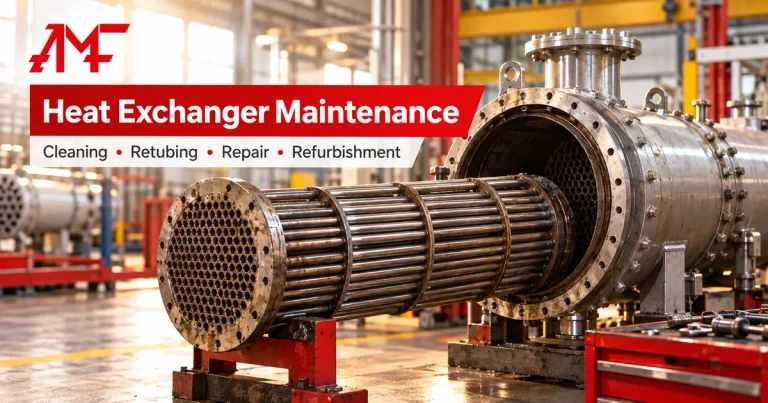
Heat Exchanger Cleaning and Refurbishment
Selecting the right equipment is only one part of maintaining reliable heat-transfer performance. Regular inspection and cleaning are also important.
Over time, deposits can accumulate on heat-transfer surfaces. Fouling can increase thermal resistance and may contribute to reduced heat-transfer performance and higher pressure drop.
For shell-and-tube equipment, maintenance can include tube cleaning, inspection, retubing, mechanical repair, pressure testing, and refurbishment, depending on the condition of the exchanger.
This is especially relevant for process plants in Singapore where heat exchangers can operate continuously under demanding conditions.
Ad-Meth Mech-Field Pte Ltd provides heat exchanger maintenance services in Singapore, including high-pressure waterjet cleaning, retubing, mechanical repair, troubleshooting, refurbishment, and on-site installation of tubular heat exchangers. The company states that its heat exchanger cleaning services can use high-pressure water up to 36,000 psi.
Cleaning requirements depend on the exchanger design and the type of deposits present. For suitable shell-and-tube applications, high-pressure waterjet cleaning can remove deposits from tube surfaces. The correct pressure, nozzle configuration, cleaning method, and safety controls should be selected according to the equipment and deposit characteristics.
When tubes are damaged or have reached the end of their service life, retubing may also be considered instead of replacing the entire exchanger.
Ad-Meth provides retubing, mechanical repair, troubleshooting, refurbishment, and fabrication services for tubular heat exchangers and other process equipment in Singapore. Its workshop and office are located at 75 Tuas South Street 5, Singapore 637383.
How to Choose a Heat Exchanger in Singapore
When selecting a heat exchanger Singapore process facility, engineers should evaluate the complete operating conditions rather than focusing on one specification.
Important factors include:
- Required heat-transfer duty
- Fluid type and properties
- Inlet and outlet temperatures
- Operating pressure
- Flow rates
- Allowable pressure drop
- Fouling potential
- Corrosion considerations
- Materials of construction
- Available installation space
- Cleaning and maintenance requirements
- Expected operating life
- Applicable engineering standards
For larger industrial projects, both thermal and mechanical design should be completed before the final equipment configuration is selected.
Why Professional Heat Exchanger Maintenance Matters
A heat exchanger may gradually lose performance as fouling, corrosion, erosion, tube damage, gasket deterioration, or other mechanical issues develop. Early inspection can help identify these problems before they cause a more serious process interruption.
For Singapore’s petrochemical, chemical, process, and other industrial facilities, professional maintenance can include inspection, cleaning, repair, retubing, refurbishment, and testing according to the equipment’s condition and maintenance requirements.
Ad-Meth Mech-Field Pte Ltd has specialized in heat exchanger and air-fin cooler fabrication, refurbishment, and maintenance for Singapore’s petrochemical and process industries since 1991. Its current service scope includes heat exchanger cleaning, mechanical repair, retubing, fabrication, refurbishment, and on-site installation.
Understanding the difference between plate type and shell type heat exchanger is important when selecting thermal equipment for industrial operations in Singapore.
Plate heat exchangers offer a compact configuration and can provide strong heat-transfer performance for many applications, particularly liquid-to-liquid services. Shell-and-tube heat exchangers, meanwhile, offer extensive design flexibility and are widely used in demanding process environments.
The right choice depends on the process rather than a simple comparison of the two technologies. Pressure, temperature, fluid characteristics, heat-transfer duty, fouling, materials, available space, maintenance requirements, and applicable design standards should all be considered.
For businesses looking for heat exchanger Singapore services, Ad-Meth Mech-Field Pte Ltd provides heat exchanger cleaning, refurbishment, retubing, mechanical repair, fabrication, and on-site installation services from its Tuas South facility. With experience serving Singapore’s petrochemical and process industries since 1991, the company provides a range of mechanical engineering and turnaround maintenance services for industrial process equipment.
Frequently Asked Questions About Heat Exchangers in Singapore
What is the difference between a plate type and shell type heat exchanger?
A plate heat exchanger transfers heat through a series of corrugated plates that create separate flow channels. A shell-and-tube heat exchanger transfers heat through tube walls between fluids flowing through the tubes and the shell side.
Which heat exchanger is more efficient?
Neither type is universally more efficient. Plate heat exchangers can provide high heat-transfer performance in many liquid-to-liquid applications, while shell-and-tube exchangers can be designed for a broad range of demanding process conditions. Actual performance depends on the thermal design and operating conditions.
Are shell-and-tube heat exchangers suitable for Singapore's process industries?
Yes. Shell-and-tube heat exchangers are widely used for industrial process applications, including chemical processing, oil and gas, petrochemical, and power-generation duties. Their suitability depends on the required thermal and mechanical specifications.
How often should a heat exchanger be cleaned?
There is no single cleaning interval that applies to every heat exchanger. Cleaning frequency depends on the fluid, fouling rate, operating conditions, pressure drop, heat-transfer performance, and plant maintenance strategy. Condition-based inspection and performance monitoring can help determine when cleaning is required.
Can a damaged shell-and-tube heat exchanger be repaired?
In many cases, yes. Depending on the damage, repairs may include tube plugging, retubing, mechanical repair, refurbishment, or replacement of specific components. The appropriate method should be determined after inspection.