
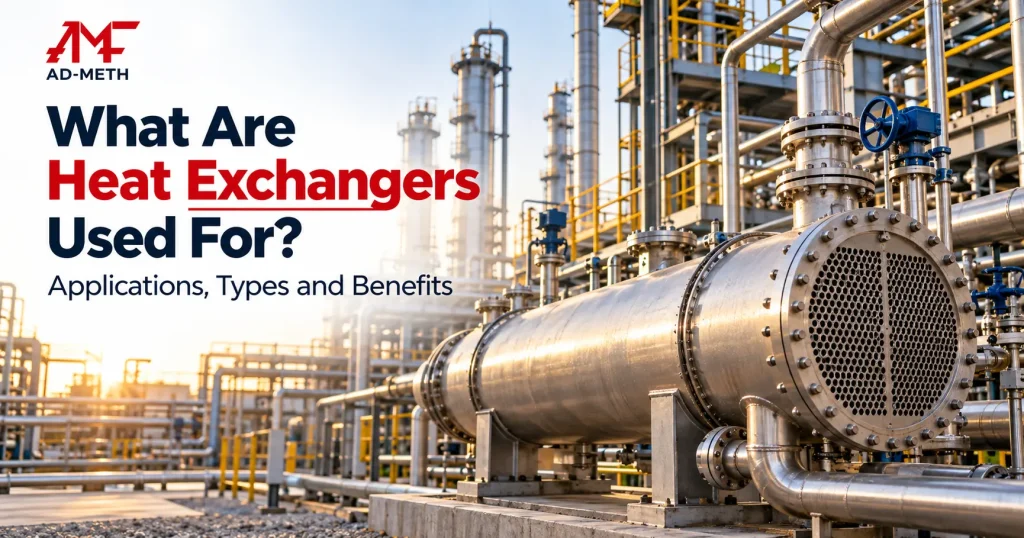
What Are Heat Exchangers Used For Key Applications
Heat exchangers are widely used in industrial and commercial systems to transfer heat from one fluid or medium to another without directly mixing them. They play an important role in controlling temperatures, recovering heat and maintaining efficient operation across many types of equipment and processes.
From manufacturing plants and power generation facilities to chemical processing and HVAC systems, heat exchangers are used whenever heat needs to be transferred, removed or recovered efficiently.
What Are Heat Exchangers Used For?
The primary purpose of a heat exchanger is to transfer thermal energy between two fluids or between a fluid and another medium. Depending on the application, a heat exchanger can be used to heat, cool, condense or recover heat from a process.
Common applications include:
- Cooling industrial equipment and process fluids
- Heating water and other fluids
- Recovering waste heat
- Condensing steam or other vapors
- Maintaining process temperatures
- Supporting refrigeration and air-conditioning systems
- Controlling temperatures in chemical and manufacturing processes
The exact application depends on the type of heat exchanger, the fluids involved and the operating conditions.
How Does a Heat Exchanger Work?
A heat exchanger transfers heat between two fluids while keeping them separated by a heat-transfer surface.
For example, a hot process fluid can pass through one side of a heat exchanger while a cooler fluid flows through the other side. Heat moves from the hotter fluid to the cooler fluid through the separating surface.
The fluids generally do not need to come into direct contact. Instead, heat is transferred through materials such as metal tubes or plates that allow thermal energy to pass between the fluids.
The basic process is:
- A hot fluid enters the heat exchanger.
- A cooler fluid enters through a separate flow path.
- Heat moves from the hotter fluid toward the cooler fluid.
- The fluids leave at different temperatures.
- The process continues as part of the wider industrial system.
Why Are Heat Exchangers Important?
Heat exchangers help industries control temperature while making effective use of available thermal energy.
Without suitable heat-transfer equipment, many industrial processes would require additional energy or separate cooling and heating systems.
Heat exchangers can help businesses:
Improve Energy Efficiency
Heat can sometimes be recovered from one part of a process and reused elsewhere. This can reduce the amount of additional energy required for heating.
Maintain Process Temperatures
Many industrial processes need to operate within specific temperature ranges. Heat exchangers help provide controlled heating or cooling.
Support Equipment Performance
Industrial equipment can generate significant amounts of heat during operation. Heat exchangers can be used to remove excess heat and help maintain suitable operating conditions.
Recover Waste Heat
Heat that would otherwise be lost can potentially be transferred to another fluid or process, depending on the system design.
What Industries Use Heat Exchangers?
Heat exchangers are used across a wide range of industries because temperature control and heat transfer are fundamental to many industrial processes.
Chemical and Petrochemical Industry
Chemical processing often involves heating, cooling, condensation and evaporation. Heat exchangers can support these processes by transferring thermal energy between process streams.
Power Generation
Power plants use heat exchangers in various stages of power generation, cooling and steam-related processes.
Manufacturing
Manufacturing facilities may use heat exchangers for process heating and cooling, equipment cooling and temperature management.
Oil and Gas
Heat exchangers can be used for heating, cooling and condensation in different stages of oil and gas processing.
Food and Beverage
Temperature control is important in food and beverage processing. Heat exchangers can be used for heating, cooling and other thermal processing applications.
HVAC and Refrigeration
Heat exchangers are also found in heating, ventilation, air-conditioning and refrigeration systems, where they help transfer heat between different fluids or air streams.
What Is a Shell and Tube Heat Exchanger Used For?
A shell and tube heat exchanger is one of the common types of industrial heat exchangers. It consists of a series of tubes enclosed within a larger shell.
One fluid flows through the tubes while another fluid flows around the tubes inside the shell. Heat passes through the tube walls from one fluid to the other.
Shell and tube heat exchangers can be used for applications such as:
- Process fluid cooling
- Process fluid heating
- Water cooling
- Steam condensation
- Oil cooling
- Industrial process temperature control
Because they are used in industrial environments, proper inspection and maintenance are important for maintaining their performance.
Different exchanger designs suit different operating requirements, so understanding the differences between plate type and shell type heat exchangers can help when selecting equipment for an application.
Why Do Heat Exchangers Need Cleaning?
Over time, deposits can accumulate on heat-transfer surfaces. Depending on the application and operating conditions, these deposits may include scale, rust, sludge, residue and other contaminants.
When deposits build up, they can interfere with heat transfer and reduce the effectiveness of the equipment.
For shell and tube heat exchangers, deposits may accumulate inside tubes and on internal surfaces. Regular inspection and appropriate cleaning can therefore be an important part of industrial maintenance. Businesses dealing with significant scale, rust or sludge buildup may also need specialized heat exchanger cleaning services in Singapore
How Are Heat Exchangers Cleaned?
The appropriate cleaning method depends on the heat exchanger design, type of deposit and condition of the equipment.
One method used for industrial heat exchanger maintenance is high pressure waterjet cleaning. Pressurized water can be directed toward contaminated surfaces to remove accumulated deposits.
For suitable applications, hydrojet cleaning can help remove:
- Scale
- Rust
- Sludge
- Residue
- Other accumulated deposits
The required water pressure and cleaning technique should be selected according to the equipment and cleaning requirements.
Heat Exchanger Maintenance in Singapore
Choosing an experienced heat exchanger specialist in Singapore can also be important when equipment requires inspection, cleaning, repair or ongoing maintenance. For companies operating industrial facilities in Singapore, regular heat exchanger maintenance can help support reliable equipment operation.
Ad-Meth Mech-Field Pte Ltd provides high pressure waterjet cleaning and heat exchanger cleaning solutions for industrial applications. . Its waterjet cleaning capability uses pressures ranging from 1,000 to 10,000 psi, depending on the application.
The company also provides cleaning solutions for shell and tube heat exchangers, where accumulated deposits can affect heat-transfer surfaces and equipment performance.
As part of its process and turnaround maintenance services, Ad-Meth supports businesses requiring specialized industrial maintenance solutions.
Industrial maintenance projects may also require replacement components and other industrial material supply support alongside cleaning and servicing.
So, what are heat exchangers used for? They are primarily used to transfer heat between fluids or other media for applications such as heating, cooling, condensation, temperature control and heat recovery.
Because heat exchangers are essential to many industrial processes, maintaining their heat-transfer surfaces is an important part of equipment maintenance. For shell and tube heat exchangers, appropriate cleaning can help address accumulated scale, rust, sludge and residue.
For industrial facilities in Singapore, Ad-Meth Mech-Field Pte Ltd provides heat exchanger and high pressure waterjet cleaning solutions designed for industrial maintenance and turnaround requirements.
Frequently Asked Questions About Heat Exchangers
What is the main purpose of a heat exchanger?
The main purpose of a heat exchanger is to transfer heat between two fluids or media without necessarily mixing them. It can be used for heating, cooling, condensation and heat recovery.
Where are heat exchangers commonly used?
Heat exchangers are commonly used in chemical processing, power generation, manufacturing, oil and gas, food and beverage, HVAC, refrigeration and other industrial applications.
What does a shell and tube heat exchanger do?
A shell and tube heat exchanger transfers heat between two fluids. One fluid flows through tubes while the other flows around the tubes inside a shell.
Why do heat exchangers need cleaning?
Deposits such as scale, rust, sludge and residue can accumulate on heat-transfer surfaces. This buildup can interfere with heat transfer and affect equipment performance.
Can high pressure waterjet cleaning be used on heat exchangers?
Yes. High pressure waterjet cleaning can be used for suitable heat exchanger maintenance applications. The pressure and cleaning method should be selected according to the equipment, deposit type and operating requirements.
How often should a heat exchanger be cleaned?
There is no single cleaning interval that applies to every heat exchanger. Cleaning frequency depends on the equipment, process conditions, fluid characteristics and level of deposit buildup. Inspection and maintenance requirements should be assessed for each application.